Model CD1, single speed wire rope electric hoist is small-sized lifting equipment, which can be mounted on single beam, overhead, gantry and jib cranes, with slight modification; it can also be used as a winch.
MORE
HOT PRODUCTS

Model CD1, single speed wire rope electric hoist is small-sized lifting equipment, which can be mounted on single beam, overhead, gantry and jib cranes, with slight modification; it can also be used as a winch.
MORE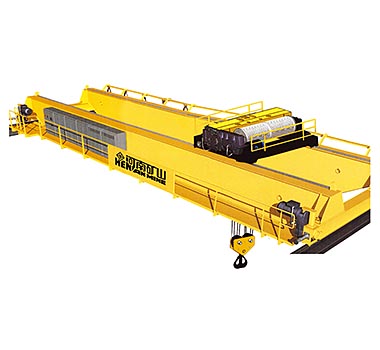
HNKS Crane Co., Ltd is one of Chinese leading manufacturers of many kinds’ cranes. Such as overhead Crane, gantry crane, European crane, tire rubber crane, metallurgy crane, portal crane, jib crane, electric hoist, grab bucket, etc.Welcome to Changyuan ...
MORE
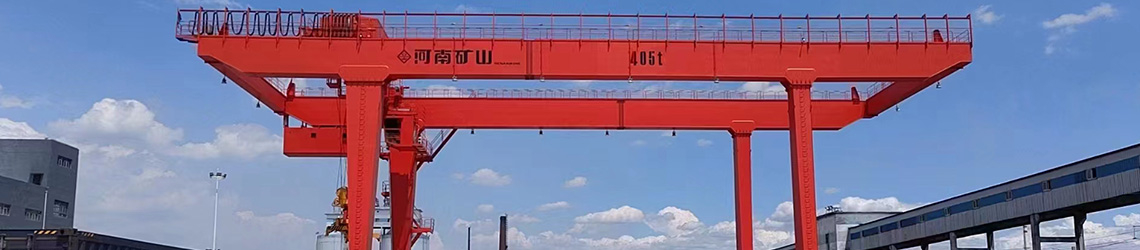
Gantry Crane actually is overhead crane with legs, it’s normally worked outdoors, and also sometimes indoors
MORE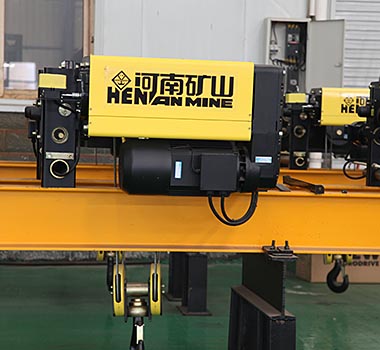
European wire ripe electric hoist adopts the European FEM design standards with advanced concept, the operation is simple, convenient and working is safety and efficient and meet the low noise, energy conservation and environment protection requiremen...
MORE2×15(7.5+7.5)t Fully Automatic Steel Plate Handling Bridge Crane | Henan Mine Crane
2025-11-20
Recently, Henan Mine Crane provided a comprehensive, fully automated solution for steel plate slitting to Shandong Iron & Steel Group, designed for processing various high-end medium-to-heavy plates, such as those used in shipbuilding and offshore engineering. Centered on the fully automatic steel plate handling bridge crane and material handling and lifting system, the solution integrates a complete automated workflow—including laser cutting and slitting, surface inkjet marking, side stamping, and the warehousing of finished cut-to-length plates—marking an upgrade from traditional material handling to the provision of integrated production line services.
In the current steel plate processing industry, traditional production models face numerous bottlenecks regarding efficiency and management. These pain points are not isolated incidents but rather common, long-standing issues across the industry:
From material arrival and loading to process transfers and unloading, every step requires coordination between overhead crane operators and ground signalers. Communication relies on hand signals and two-way radios, limiting the pace of operations, and errors are particularly likely during night shifts. Even with conventional overhead cranes, without a fully automatic steel plate handling bridge crane, manual command remains unavoidable.
Aligning, placing, and setting the cutting start point for large slabs depend entirely on the operator's individual experience. The same workpiece may yield different results when processed by different teams, requiring extra time for adjustments during subsequent assembly and welding.
High-end medium-to-heavy plates carry high individual value. Any surface damage caused by swaying or collisions during lifting can lead to downgrading the material or even scrapping the entire plate—often resulting in losses amounting to tens of thousands of yuan.
Tasks such as inkjet marking, steel stamping, and logbook entries are distributed across multiple workstations. Errors—such as incorrect writing, omissions, or miscopying numbers—are common, making it difficult to provide concrete evidence when customers inquire about heat numbers or batch numbers.
Operations involve heavy-load lifting, high-temperature cutting, and the movement of personnel on the shop floor; negligence at any stage can lead to accidents.
These pain points are not isolated incidents but rather common, long-standing issues within the industry. Precisely for this reason, an increasing number of steel plate processing companies are asking the same question: Is there a system capable of fully automating and integrating the entire workflow—from handling and cutting to marking and warehousing? This is the very question addressed by the solution we have delivered.
In short: Leveraging the fully automatic steel plate handling bridge crane and material handling systems, multiple previously fragmented processes are integrated into a fully automated production line that requires no manual intervention.
This solution is designed for the processing of high-end medium-to-heavy steel plates (particularly shipbuilding and offshore engineering grades) and integrates the following key stages:
1. Laser Cutting: Replaces traditional manual oxy-fuel or plasma cutting with laser cutting for plate sectioning; this yields cleaner cut edges and superior dimensional control, while enabling the single-step formation of complex shapes and weld bevels.
2. Surface Inkjet Marking: Automatically prints identification data—such as specifications, heat numbers, and batch numbers—onto the plate surface immediately after cutting, effectively assigning a unique "ID" to each plate from the moment it enters the line.
3. Side Stamping: Automatically stamps the steel grade onto the plate edge to facilitate subsequent lifting, shipping, and on-site identification, allowing for quick verification even when the plate surface is obscured.
4. Finished Product Warehousing: Following cutting to order-specific dimensions, finished plates are automatically lifted and placed into storage, seamlessly integrating with warehouse management systems.
Across the entire line—from initial entry to final warehousing—processes such as lifting, positioning, cutting, inkjet marking, stamping, and transfer are fully automated and require no manual intervention, marking a transition from the use of standalone material handling equipment to a comprehensive, integrated production line solution.
Many people ask: since there are dedicated machines for cutting and coding, why is the entire solution built around a "lifting and material handling system"?
The pace and quality of a steel plate processing line are often determined not by the cutting process itself, but by the flow of materials. From the moment steel plates arrive until they become finished products, they undergo countless lifting operations—including loading, transferring between stages, unloading, repositioning, and warehousing. Only when lifting is fast, stable, and precise can the subsequent cutting and marking processes maintain a consistent output.
In this system, the fully automatic steel plate handling bridge crane plays the role of the "main artery":
Loading stage: Automatically lifts and transports entire slabs from the raw material area to the cutting station, followed by automatic alignment and positioning.
Process transfer stage: Transports cut plates between workstations according to the production sequence, linking the cutting, inkjet marking, and steel stamping processes.
Warehousing stage: Automatically lifts and transports finished, cut-to-size products to designated storage locations to complete the warehousing process.
What enables these movements to execute autonomously is an integrated intelligent scheduling and control system. This system manages the autonomous planning, precise positioning, and efficient coordination of material hoisting and transport; the scheduling logic centrally determines when to hoist, the destination, the travel path, and the precise placement point, rather than relying on the operator's real-time judgment.
Zooming out to view the entire production line's daily operation: raw steel plates arrive → an automated system dispatches overhead cranes to load the material → laser cutting and forming → automatic inkjet marking → automatic side stamping → fixed-length sorting → automatic warehousing of finished products. Between each stage, material handling is seamlessly managed by automated lifting and transport systems, while information flow is centrally controlled by a scheduling system; the entire process operates in a closed loop without the need for manual intervention.
This closed-loop design delivers three immediate benefits:
Consistent Pace: The production line's cycle time is centrally controlled by the system, eliminating disruptions caused by personnel conditions or shift changes and enhancing continuous operational capability.
Seamless Integration: The completion of one process step immediately triggers the next, minimizing idle time and making output per unit of time more predictable.
Process Transparency: Every step is traceable, allowing managers to know at any moment exactly where materials are located and which stage of the process they have reached.
Additionally, the solution includes an interface for wireless remote control—a feature we will discuss in detail in the next section, as it is key to ensuring a "one-time investment with long-term adaptability."
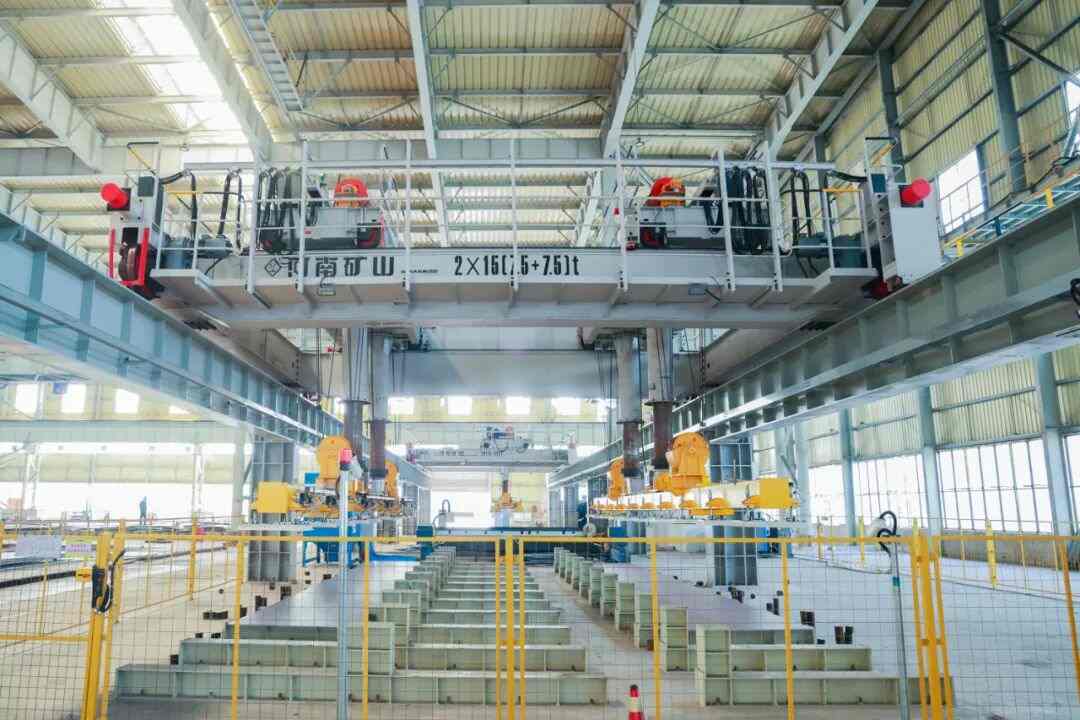
What is the biggest challenge for automated production lines? Rigidity—specifically, the tendency to grind to a halt when faced with maintenance, abnormal operating conditions, or urgent, unscheduled orders. To address this, we adopted a dual-mode design featuring both "intelligent" and "remote control" capabilities:
Automatic Mode: Under normal operating conditions, an integrated intelligent scheduling and control system takes the lead. It autonomously plans material handling, ensures precise positioning, and facilitates seamless transitions between process steps, allowing the line to operate fully automatically.
Remote Control Mode: In scenarios such as equipment maintenance, special operating conditions, or ad-hoc tasks, operators can flexibly take manual control via a wireless remote, enabling lifting operations to proceed independently of the scheduling system.
Why this design? Because industrial environments always involve "unplanned" events. Full automation ensures high day-to-day efficiency, while remote control guarantees operational continuity during exceptional situations—reducing manual strain while ensuring work remains uninterrupted. For the purchaser, this means the system is not locked into a single mode of operation; instead, it adapts to process adjustments and production line changes, delivering "one-time investment, long-term adaptability."
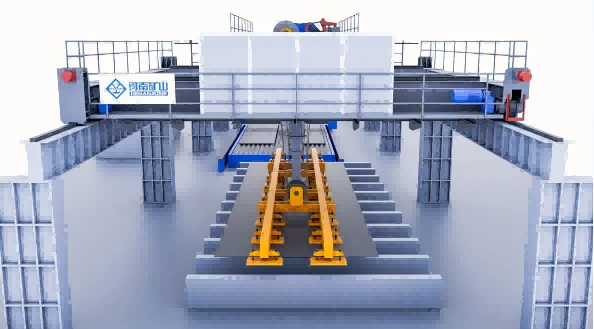
What is the most immediate challenge in lifting and transporting medium-to-heavy steel plates? Stability. If a steel plate weighing ten or even dozens of tons begins to sway in mid-air, its landing position will drift off-target, requiring repeated adjustments for cutting alignment—thereby compromising both efficiency and safety.
This solution ensures stability through a dual-layer approach:
Drive and Control Layer: It utilizes a combination of variable frequency drives (VFDs) and PLCs to ensure smooth, controllable travel speeds for the trolley and crane bridge, as well as precise lifting movements. Integrated position feedback (such as encoders) ensures that lifting operations are consistent and repeatable.
Anti-Sway Layer: This employs a two-pronged strategy. First, an intelligent anti-sway function uses control algorithms to suppress oscillation during transport. Second, a rigid anti-sway spreader structure mechanically restricts the spreader's movement. The combination of software and structural design guarantees stable lifting and precise positioning.
For large-format, high-value plates—such as those used in shipbuilding and offshore engineering—"stable lifting" directly translates to "accurate placement, minimal impact damage, and reduced scrap rates."
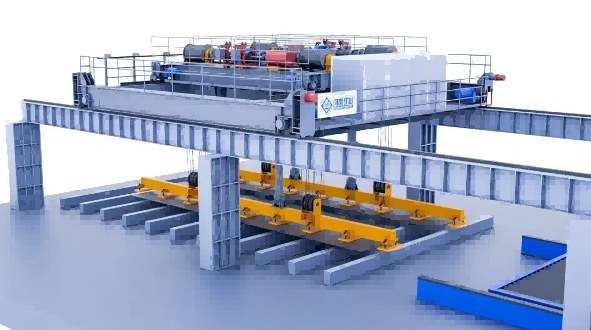
In heavy-load lifting and automated operations, safety is always the top priority.
This solution incorporates a systematic approach to safety, featuring:
Safety Interlocks: Critical actions are interlocked so that the next step cannot proceed unless specific conditions are met, logically preventing operational errors.
Protective Measures: A combination of mechanical and electrical safeguards provides early warnings and physical barriers when personnel approach hazardous areas.
Video Surveillance: Full visibility of key workstations and lifting paths allows managers to monitor the site in real-time and review footage for traceability.
Laser Anti-Collision Systems: Laser-based distance sensing detects obstacles, triggering early deceleration and stopping to prevent collisions between the crane, lifting gear, and equipment or personnel.
Drive Control: Multiple layers of protection for drive systems—such as hoisting and travel mechanisms—ensure a rapid response to any anomalies.
The goal of this comprehensive system is to ensure safety coverage across every stage—from lifting and cutting to transfer and warehousing—reflecting our fundamental commitment to heavy-load operations.

This comprehensive, fully automated solution for the entire steel plate splitting process is not limited to shipbuilding and offshore engineering applications; leveraging a core foundation of heavy-load material handling—and incorporating tailored adjustments to lifting gear, software logic, and process modules—it can be replicated and expanded to various other plate processing and heavy material handling scenarios, meeting the diverse production line upgrade needs of different customers.
1. Steel Structure Processing Line: Handles plate processing for architectural steel structures and bridge components. It automates the entire workflow—from lifting raw heavy plates and cutting/dividing to marking, sorting by size, and automated warehousing—minimizing handling damage and enabling full traceability of components.
2. Steel Processing & Distribution Center: Designed for third-party service providers, this center integrates slitting, cutting, marking, and warehousing/dispatch for a wide range of medium-to-heavy plates, alloy plates, and stainless steel plates, supporting flexible production for orders of various specifications.
3. Construction Machinery Plate Workshop: A plate-cutting section for OEMs manufacturing excavators, cranes, and mining equipment. It automates high-strength steel plate loading/unloading, cutting, stamping/coding, and semi-finished product transfer, matching the high-volume processing pace of OEM component manufacturing.
4. Pressure Vessel & Oil/Gas Equipment Plate Processing: Handles cutting for vessel and boiler plates, automating lifting, cutting, material identification, and stack-based warehousing to meet the pressure vessel industry's rigorous standards for batch traceability and lifting stability.
5. Rail Transit Plate Production Section: Processes heavy plates for train bodies and rail equipment, automating handling, precision cutting, marking/record-keeping, and finished-product warehousing to ensure processing accuracy and production continuity.
6. Intelligent Retrofitting of Legacy Workshops: Upgrades existing steel mills and plate processing facilities without requiring major civil engineering reconstruction. By retaining the original building structure while upgrading lifting systems, process units, and control systems, it transforms traditional lines into automated, closed-loop systems and includes interfaces for remote control and future functional expansion.
7. Intelligent Plate Storage Zone: By isolating the stripping, cutting, and slitting units and activating only the modules for lifting and handling, identification and marking, and automated stacking and warehousing, this setup serves as the core system for an intelligent medium-to-heavy plate warehouse. It enables automated warehousing, categorized stacking, and on-demand retrieval scheduling, thereby enhancing the storage zone's turnover efficiency.
Customized solutions can be implemented across various scenarios by changing the type of lifting device, adjusting PLC program logic, and adding or removing process modules to accommodate differences in plate thickness, tonnage, and processing techniques.
Looking ahead, Henan Mine Crane will continue to focus on the intelligent and automated upgrading of industrial equipment, deeply address the needs of specific market segments, and optimize its products and full-lifecycle solutions, thereby empowering the high-quality development of the manufacturing industry through "Mine Source" intelligent manufacturing.
