Model CD1, single speed wire rope electric hoist is small-sized lifting equipment, which can be mounted on single beam, overhead, gantry and jib cranes, with slight modification; it can also be used as a winch.
MORE
HOT PRODUCTS

Model CD1, single speed wire rope electric hoist is small-sized lifting equipment, which can be mounted on single beam, overhead, gantry and jib cranes, with slight modification; it can also be used as a winch.
MORE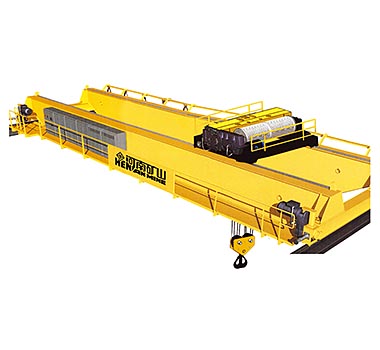
HNKS Crane Co., Ltd is one of Chinese leading manufacturers of many kinds’ cranes. Such as overhead Crane, gantry crane, European crane, tire rubber crane, metallurgy crane, portal crane, jib crane, electric hoist, grab bucket, etc.Welcome to Changyuan ...
MORE.jpg)
Gantry Crane actually is overhead crane with legs, it’s normally worked outdoors, and also sometimes indoors
MORE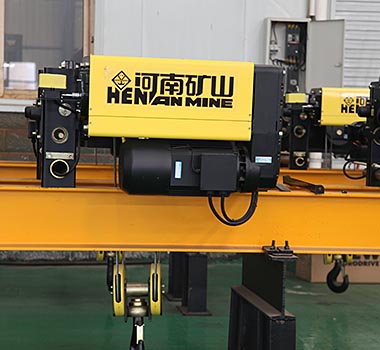
European wire ripe electric hoist adopts the European FEM design standards with advanced concept, the operation is simple, convenient and working is safety and efficient and meet the low noise, energy conservation and environment protection requiremen...
MORE450t Four-Beam Four-Rail Casting Crane Serves For steel Making Factory | Henan Mine Crane
2026-08-06
casting cranes for ladle handling are specialized cranes used in the continuous casting process of steelmaking to lift molten metal. Their main tasks include adding molten iron to the converter and transporting molten steel to the refining furnace or the continuous casting ladle turret.
In this core process of molten metal lifting, the equipment must simultaneously meet five key requirements: extremely large load capacity, extremely long span, high-temperature environmental tolerance, continuous high-intensity operation, and absolute safety and reliability. The working environment is characterized by high temperatures and high dust levels, requiring a high operating level (typically A7 or A8), and necessitating extremely high equipment safety standards.
The steel industry is accelerating its transformation towards large-scale, continuous, intelligent, and green production. Electric arc furnace (EAF) steelmaking, with its advantages of short process, low emissions, and high efficiency, has become an important direction for industry restructuring. As steelmaking furnaces continue to expand and production pace accelerates, traditional metallurgical casting cranes are increasingly unable to meet the demands of modern metallurgical production in terms of lifting capacity, structural stability, operational precision, safety redundancy, and intelligent control.
The 450t four-beam four-rail casting crane (ladle crane) custom-designed for steel plants by Henan Mine Crane is currently the largest, most technologically advanced, most reliable, safest, and best-configured machine for EAF steelmaking processes. It primarily handles the lifting and transport of molten metal in steel and iron plants and has received unanimous praise from users in the metallurgical industry.
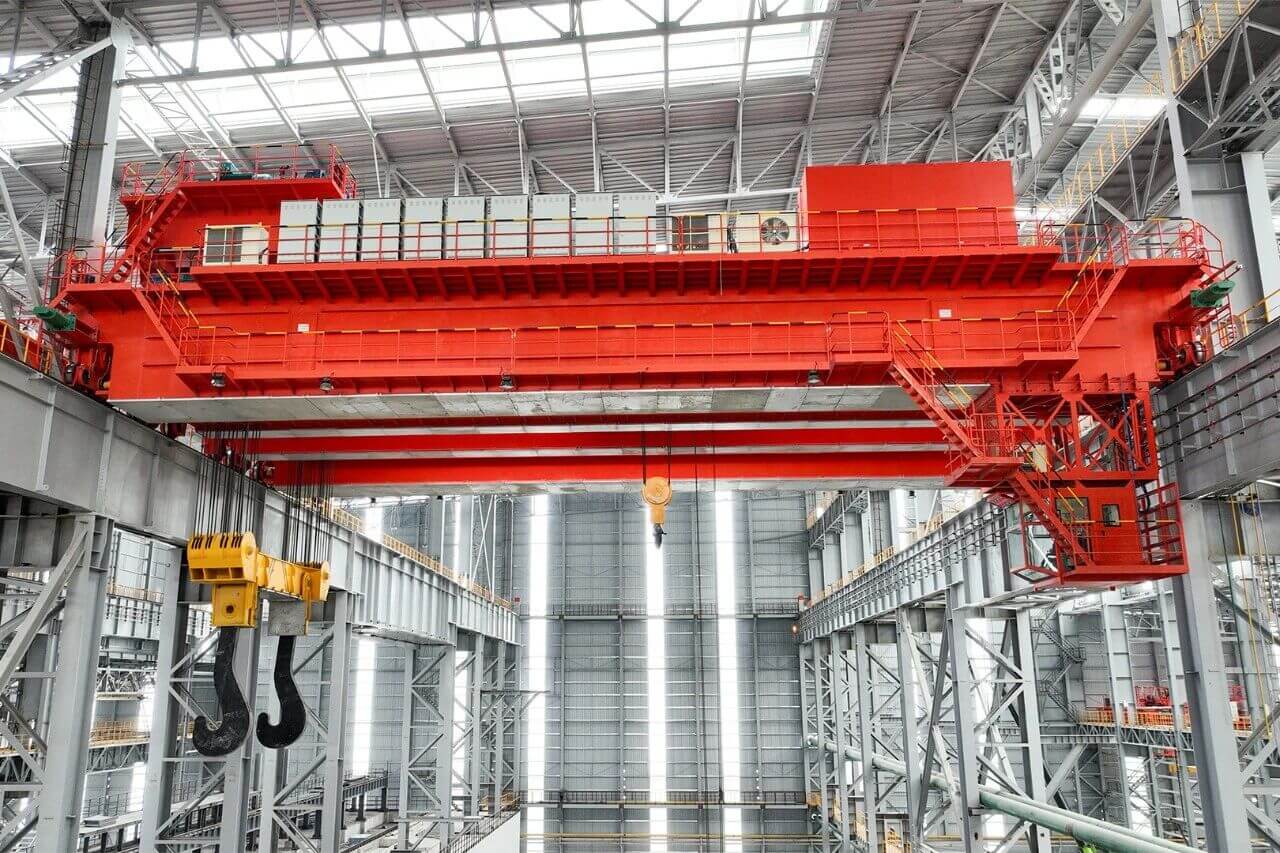
Metallurgical ladle cranes are machines that operate by longitudinal movement along factory tracks, lateral movement of the trolley, and lifting/lowering of the hook. They are primarily used in steelmaking continuous casting processes to lift molten metal (such as iron and steel), specifically including adding molten iron to the converter and transporting molten steel to the refining furnace or continuous casting ladle turret. Their working environment is harsh, characterized by high temperatures and high dust levels, requiring high operating levels (A7, A8) and extremely high equipment safety standards. Metallurgical casting cranes are specialized cranes conforming to standards such as JB/T7688.1-95 and JB/T7688.15-95 for lifting molten metal. Generally applicable to ambient temperatures from -10℃ to +50℃, with relative humidity not exceeding 50% at 40℃, and the radiant temperature of the molten metal being hoisted on the forging hook or plate hook not exceeding 300℃.
According to the safety regulations of the "Safety Technical Regulations for Lifting Machinery," the hoisting of molten metal must be carried out using a dedicated metallurgical casting crane (such as a fixed gantry hook casting crane). The use of ordinary cranes is strictly prohibited to prevent major safety accidents such as the overturning of molten steel ladles.
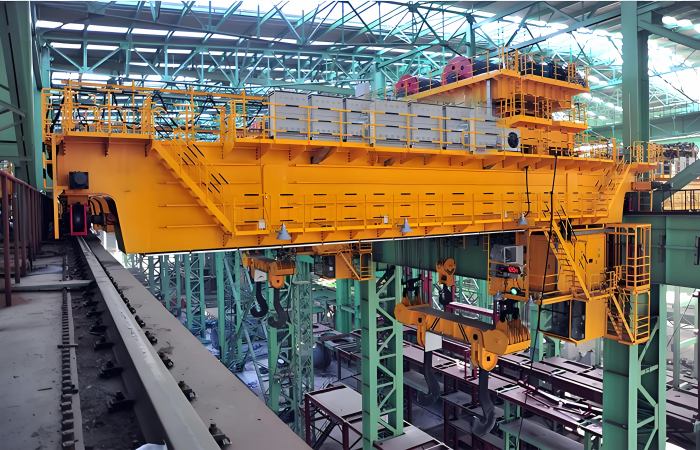
3.1 Structural Form
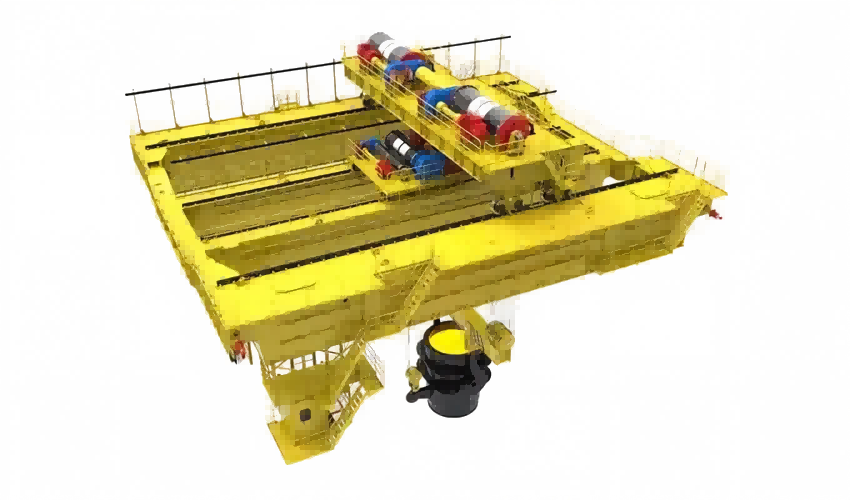
The main structural forms of casting cranes hand ladle handling include: four-beam four-rail double trolley, four-beam six-rail double trolley, double-beam single trolley, and double-beam mother-daughter trolley. For large casting cranes (over 300 tons), the main hoisting mechanism mainly has the following structural forms: integral large reducer type, three reducer type, and double reducer type. Among them, the integral large reducer type can improve the stress state of the main trolley and improve safety and reliability.
Due to the harsh working environment, its key components must meet special requirements. The lifting hooks are usually special metallurgical plate hooks. The wire rope and hook assembly must be high-temperature resistant. The wheels use composite rolled forged steel wheels, and cast iron pulleys are not used. The main beam body uses high-temperature resistant protective materials. The electrical parts (motor, cable) must also meet high-temperature resistance requirements.
| Model | Name | Feature |
| YZ | Double-bean casting crane | It adopts a double-beam, double-rail or four-rail, single (double) trolley structure. The trolley is equipped with a lifting mechanism, which can realize operations such as hoisting and turning over molten metal. The main lifting mechanism's lifting device is a gantry-type stacked plate hook, and the auxiliary lifting mechanism's lifting device is a forged hook, which is used to assist the main hook in turning over the bale or hoisting general items. |
| YZS | Four-beam casting crane | It adopts a four-beam, four-rail or six-rail, double-trolley structure. The main trolley's lifting device is a gantry-type stacked plate hook, and the auxiliary trolley's lifting device is a forged hook. Each runs on a separate track, which can realize operations such as lifting and transporting molten metal, turning over packages, and lifting general items. |
.jpg)
.jpg)
.jpg)
3.2 Technical Parameter
| Lifting Weight(t) | 180/50 | 200/50 | 225/65 | 240/75 | 280/75 | 320/80 | |
| Working Class | A7 | ||||||
| Span(m) | 28.5 | 28 | 27 | 24 | 21 | 24.5 | |
| Max Lifting Height(m) | Main | 27 | 26 | 28 | 30 | 24 | 28 |
| Auxiliary | 29 | 26 | 28 | 30 | 26 | 32 | |
| Speed(m/min) | Main Lift | 7.2 | 8 | 8 | 10 | 10 | 9 |
| Aux Lift | 9.3 | 9.3 | 10 | 10.5 | 10.5 | 10 | |
| Main Trolley Travelling | 38 | 40 | 40 | 38 | 36 | 36 | |
| Auxiliary Trolley Travelling | 40 | 40 | 38 | 40 | 39 | 39 | |
| Crane Travelling | 86 | 86 | 87 | 87 | 76 | 63 | |
| Limit Dimension(mm) | C1 | 2600 | 2600 | 3000 | 3600 | 3600 | 3600 |
| C2 | 2600 | 2600 | 2600 | 3200 | 3200 | 3300 | |
| C3 | 1600 | 1600 | 1800 | 2000 | 2000 | 2000 | |
| C4 | 2350 | 2400 | 2400 | 2500 | 2500 | 2500 | |
| H3 | 6000 | 6200 | 6200 | 6200 | 6200 | 6000 | |
| H4 | 1200 | 1500 | 1500 | 1800 | 1800 | 1800 | |
| Main Dimension(mm) | H | 6500 | 7200 | 7200 | 7500 | 7600 | 7800 |
| H2 | 5000 | 5500 | 5500 | 5000 | 5000 | 5000 | |
| H5 | 1200 | 1200 | 1200 | 1200 | 1200 | 1200 | |
| b | 450 | 500 | 500 | 500 | 500 | 500 | |
| K1 | 10600 | 10500 | 10500 | 10500 | 12000 | 12500 | |
| K2 | 3000 | 3000 | 3500 | 3500 | 3800 | 5000 | |
| B | 14800 | 17800 | 17800 | 17800 | 19200 | 19500 | |
| Steel Track Recommended | QU120 | ||||||
| Max. Wheel Pressure(kN) | 525 | 550 | 585 | 625 | 595 | 650 | |
| Power Source | Three-phase A.C.50HZ、380V | ||||||
3.3 Technical characteristics of 450t four-beam four-rail casting crane
| 01 | The four-beam, four-rail design ensures a large span and safe, stable operation. The overall large-scale reduction gear arrangement with four beams and four rails provides enhanced safety. |
| 02 | Integrated machining for longer lifespan. The entire trolley frame undergoes integral annealing and machining, resulting in higher assembly precision, smoother operation, and a longer lifespan. |
| 03 | Finite element modeling and analysis result in greater strength. The design calculations utilize finite element modeling and analysis, ensuring equal strength and lifespan for components, resulting in better structural and mechanical matching and higher cost-effectiveness. |
| 04 | The entire vehicle is PLC-controlled and features intelligent upgrades. It utilizes PLC control, is equipped with an open industrial Ethernet bus, and has reserved interfaces for future intelligent upgrades. |
| 05 | Comprehensive vehicle safety monitoring and efficient management. Equipped with a safety monitoring and management system, it provides real-time safety alarms and full-lifecycle inspection records, improving operational safety and production efficiency. |
| Comparison Dimensions | Casting crane | ordinary crane |
| Job duties | Casting cranes are specifically used in smelting workshops to lift molten steel ladles, molten iron, and other high-temperature molten metals. The working environment is characterized by high temperatures and heavy dust. | Ordinary cranes are used in general warehouses and workshops to lift goods at normal temperatures, where the environment is relatively mild. |
| Security Configuration | Casting cranes must be equipped with dual brakes (working brake + safety brake) and dual limit switches (heavy hammer type + rotary type). The hoisting mechanism must have overspeed protection and forward and reverse contactor fault protection. | A single brake and a single limit switch are sufficient to meet the basic requirements of a regular crane. |
| High temperature resistant design | The lower flange of the main beam of the casting crane must be reinforced with a heat insulation layer. The motor insulation class must be H (temperature resistance ≥180℃). The wire rope must have a high-temperature resistant metal core or asbestos core. Cast iron is strictly prohibited for pulleys. | Ordinary cranes can use conventional carbon steel and Class B insulated motors. |
| Comparison Dimensions | Casting crane | General metallurgical cranes |
| Hoisting Object | Liquid metal | Solid metal |
| Security Configuration | Equipped with dual or even triple brakes, anti-molten steel splash guards, and professional heat shields. | Standard brakes only, with simple heat insulation panels added as needed. |
| Speed | Run smoothly and slowly (to prevent liquid sloshing). | The lifting and moving speeds are relatively fast. |
| Working Class | The highest level is A8 (24-hour operation). | A6-A7 level (no need for 24-hour full load) |
| Structure | The steel structure is thicker and has stronger resistance to high-temperature deformation. | Conventional steel structure |
| Detection | All vehicles must undergo a special overload test before leaving the factory, and a special inspection must be carried out annually. | Testing was conducted according to standard procedures. |
| Personnel Qualifications | A special operation certificate for molten metal hoisting is required. | A general metallurgical crane operator's certificate is sufficient. |
.png)
Metallurgical ladle cranes are machines that operate by longitudinal movement along factory tracks, lateral movement of the trolley, and lifting/lowering of the hook. Their working environment is harsh, characterized by high temperatures and high dust levels, requiring a high level of operational capability and extremely high equipment safety standards.
.jpg)
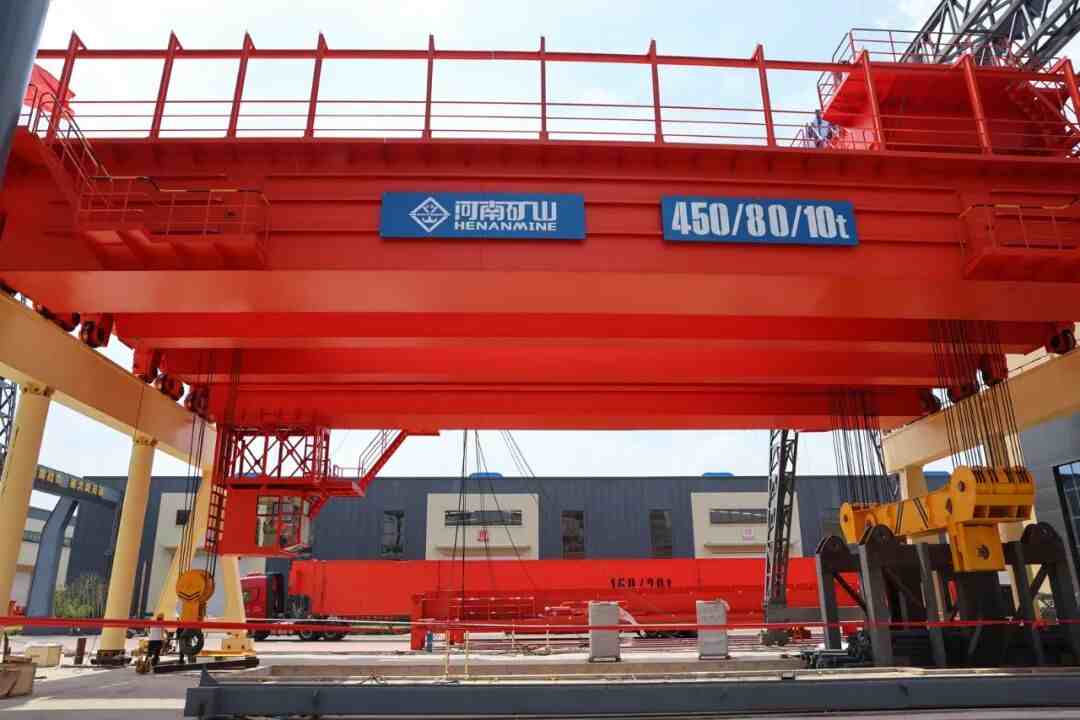
The technological development trends of metallurgical casting crane include standardized structural types, internationalized production models, generalized crane models, and specialized lifting tools. Basic transmission and control are developing towards higher reliability and precision, adopting a structure of industrial PC + PLC + basic transmission (such as frequency conversion speed regulation) to achieve fault self-diagnosis, automatic control, and networking with the factory management system. The use of star-shaped reducers in the main transmission of casting cranes is becoming a development trend, replacing traditional ratchet and pawl drives. Modernization demands are driving the development of metallurgical cranes towards larger sizes, higher speeds, and higher quality. The speed regulation system of the running mechanism has been improved from the traditional eddy current braking + steering stator voltage regulation to frequency conversion speed regulation. Detection and sensing technologies such as fault display printing, 3D positioning, and collision avoidance devices are being applied. Ergonomics are being optimized, and the operating environment is becoming more comfortable, such as adding air conditioning to the driver's cab and using inclined ladders. Safety requirements are constantly increasing. Digital technology is being used to enable intelligent control, automatic cruise, and ultra-precise positioning, providing key equipment for building "intelligent factories."
Konecranes and Demag are long-established global industry giants from Europe; Tehnoros represents the heavy lifting equipment manufacturing industry in the Russian market; and AFE Crane is a well-known supplier of lifting and material handling equipment.
Henan Mine Crane, Weihua Group, Taiyuan Heavy Industry Group, and Dalian Huarui Heavy Industry are backbone enterprises and industry representatives in China's lifting and heavy equipment manufacturing sector.
Henan Mine Crane will continue to leverage its core advantages in new-type productivity, innovate and develop high-quality, high-performance, and cost-effective cranes, and provide customers with better services, empowering the high-quality development of the manufacturing industry through high-quality intelligent manufacturing.
